What It Actually Takes to Rally a 30-Year-Old Subaru
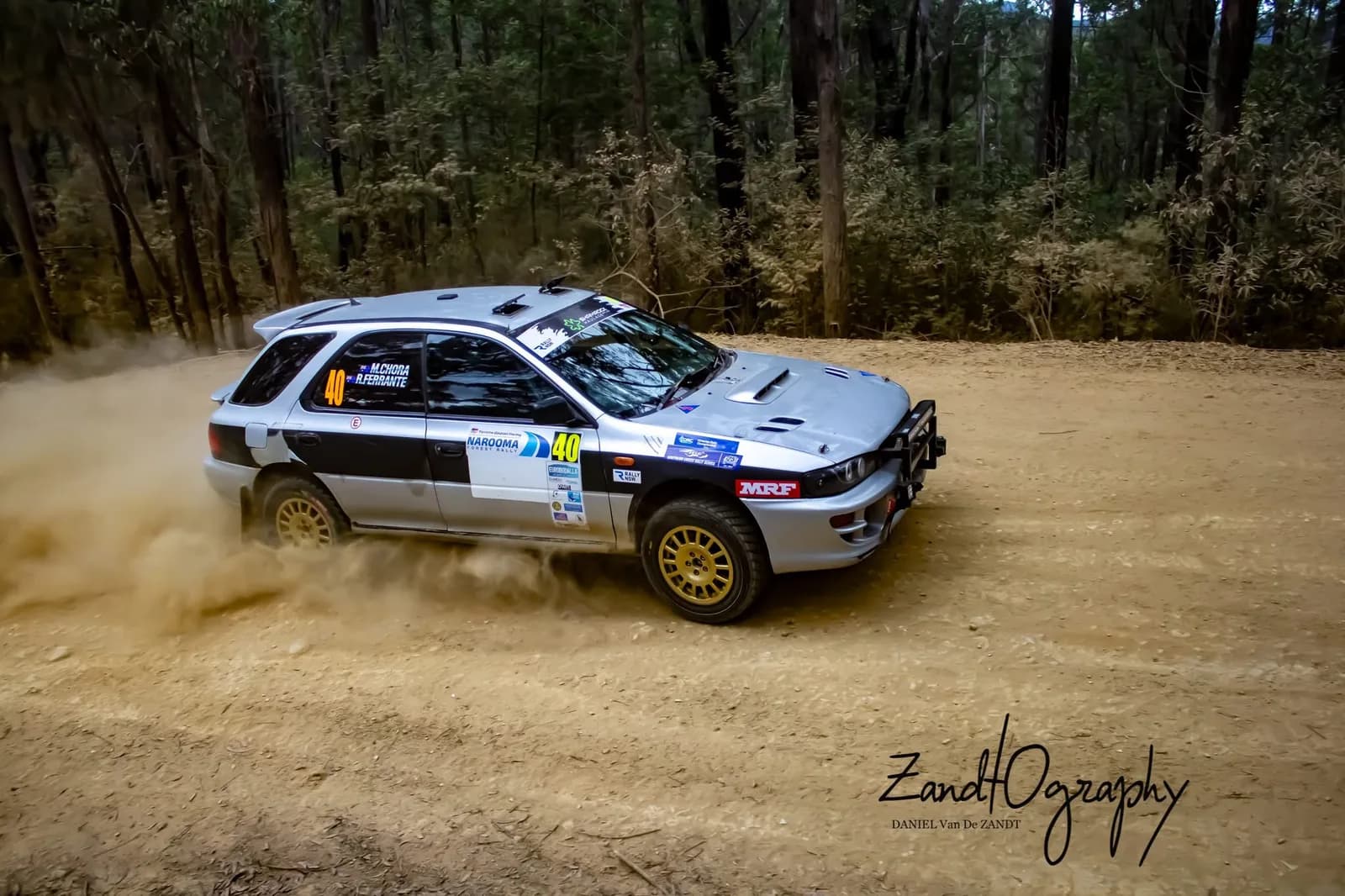
People ask what it takes to turn a classic Subaru into a rally car more than almost anything else. There's no shortage of generic build guides online — cage, harnesses, sump guard, tick the boxes. What there isn't much of is the honest version: what a 30-year-old car actually does to you across a real season of gravel rallying. So here's ours, chassis number withheld, ego mostly intact.
The car
Our weapon for the 2026 gravel campaign is a 1995 GF8 Subaru Impreza WRX STI wagon — the classic-class crowd favourite, running the earlier EJ20 2.0-litre turbocharged boxer through Subaru's symmetrical all-wheel drive. It competes in classic and P5-class categories (occasionally listed as "Impreza G7" in results) and it is, by a wide margin, the highest-mileage car in our fleet. The full spec sheet and every video it stars in are on its car profile.
What the regulations don't negotiate on
Before any of the character-building stuff below: every rally car, classic or modern, has to clear scrutineering — a compliant roll cage, harnesses, a fire extinguisher, a cut-off switch, a window net. That part isn't a build choice, it's the entry ticket, and it's not where a 30-year-old car's problems actually show up. They show up everywhere else.
What actually broke, event by event
We're not going to pretend we ran a fully sorted car from day one. Here's the real timeline.
Rally of Bathurst, March — the debut. No diffs. Point it, plant it, and it lights up whichever wheel feels like spinning. A clutch with about 10 mm of actual bite right at the top of the pedal. No ABS — a genuine surprise on gravel after a season of tarmac. A boost leak fixed trackside with a screw and a zip tie. Brakes that went to the floor at the finish. We got round anyway: 26th outright.
Mitta Mountain Rally, a week later. Same clutch, still no diffs — and this time it was also our first blind rally, so the car's quirks met a format with zero margin for error. 16th outright, plus a dent in the floor pan from a rock we never saw coming.
Rally of the Heartland, April. The old gearbox finally gave up third gear on day two of a three-day event, 330 km still to run. The fix was no fix at all — stay in fourth and fifth, don't kill it, get to the finish. It held.
Bega Valley Rally, June. Still running the original driveline at this point — diffs and the gearbox swap were still ahead of us.
Narooma Forest Rally, our ARC debut, June. The car finally got what it had been asking for all season: fresh front and rear differentials and an STI 6-speed gearbox. And — of course — the clutch that had survived four rounds on 10 mm of bite chose our biggest event yet to properly die mid-heat. We finished anyway, 18th outright, nursing every gearshift home.
What we'd tell someone starting the same build
Budget for the driveline before the paint. Diffs and a gearbox aren't glamorous, but they're the difference between a car that goes where you point it and one that just picks a direction. We ran four rounds without them and it showed in every result.
A worn clutch will not fix itself, and it will pick the worst possible moment to stop pretending. Ours gave us four events of warning. We used none of them.
Classic doesn't mean fragile, but it does mean everything is thirty years older than the parts you're used to relying on. Boost lines, brake lines, gearbox synchros — plan for the roadside fix, because eventually you'll need one.
Sourcing is half the build. The parts that suit a classic Subaru are getting genuinely hard to find, and the ones that look right often aren't — we've written up why a GDB needs a 3.545 rear diff and how to read the numbers on a used STI gearbox, because both are mistakes that cost real money. What we run and what fits a GF8 or GC8 is listed here.
Protection is the thing nobody sells you. Our floor pan wears a dent from a rock at Mitta that a proper sump guard would have taken instead. Almost nothing exists for a classic shell, which is why we've started listing what we'd build ourselves — sump guards, diff guards and line protection for exactly this kind of car.
The full story of every round — results, stage times and onboard video — is on our event index. If you're earlier in your own build than we were at Bathurst: it runs. It's meant to be figured out on the way.