What Is a Blind Rally? Inside Australia's Roadbook-Only Rallying
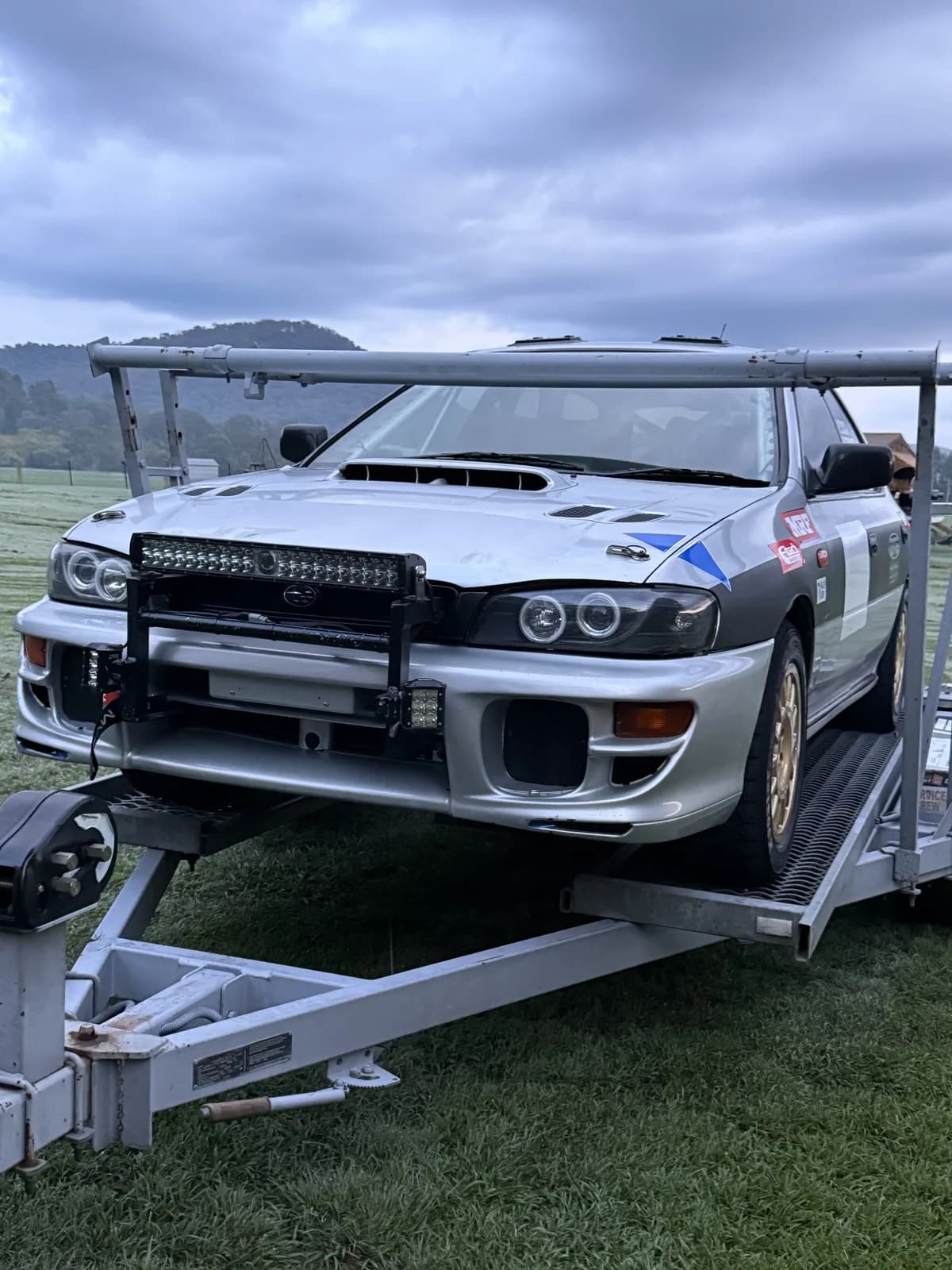
Half the rallies we've entered this year had no pace notes at all. No co-driver calling corners, no numbers, nothing telling us what's coming. Just a roadbook and whatever we could see through the windscreen. If that sounds like a strange way to go 150 km/h down a gravel road, it is — and it's also how a huge amount of Australian club rallying actually works.
The short answer
A blind rally is a rally run without pace notes and without a recce (the slow pre-event passes where crews normally write those notes). Instead, crews get a roadbook: a set of tulip diagrams and cumulative distances that keep you on the correct route. Beyond staying on the right road, you're driving to what you can actually see — full definitions of both terms are in our rally glossary.
That's the whole trick, and the whole difficulty. In a pacenoted rally, the co-driver calls the next corner a few seconds before it arrives, so the driver commits to what's coming rather than what's visible. In a blind rally, there's no "coming" — only "here."
What's actually in the roadbook
A page of tulip diagrams: simple ball-and-arrow drawings at each junction (ball = where you enter, arrow = where you exit), a distance to the next instruction, and the odd hazard warning. It keeps you on the right road. It does not tell you the corner tightens, that there's a crest with nothing behind it, or that the racing line runs straight over a rock someone else has already found.
Which of our events run blind
Three rounds we've entered so far are old-school roadbook events, run entirely without pace notes:
- Mitta Mountain Rally — six fast, narrow forest stages, no reconnaissance
- Rally of the Heartland — a three-day, 400 km road-book classic with stages up to 75 km long
- Ada River Rally — forest logging roads near Noojee, roadbook-only by design
Against that, Bathurst, Rally of the Bay and our ARC debut at Narooma were all pacenoted — Narooma was in fact the first time we'd ever written our own pace notes, after a year of driving blind. If you want the mechanics of how notes get written, that's covered in how rally pace notes work.
What it actually feels like
Mitta taught us the hard way. Nobody calls the corner; you drive to what you can see, and at real speed that margin disappears fast. Following the tracks of the cars ahead put us right on the racing line — and right onto a rock we never saw, hard enough to dent the floor pan. The second rock we did see, panicked, and somehow steered straight onto it anyway.
The Rally of the Heartland added a variable pace notes can't fix either way: darkness. Running roadbook-only stages at night, with our light bar down to standard beams after it failed on day two, meant the margin between "I can see this" and "I can't" became the entire game. Full account in the Heartland recap.
So which is harder?
Different disciplines, different fear. Pacenoted rallying is faster and more precise, but only as good as the notes — get a call wrong (or trust a bad one) and you're off just as fast. Blind rallying is simpler in principle and scarier in the seat, because there's no information between "now" and "the corner." What both actually reward is the same thing: trusting the system in front of you — the notes, the roadbook, your co-driver — more than your own eyes in the moment. We're still working on that.
More from the season: the rally glossary for every term you'll hear at an event, or every round we've entered for the full stage-by-stage record.